
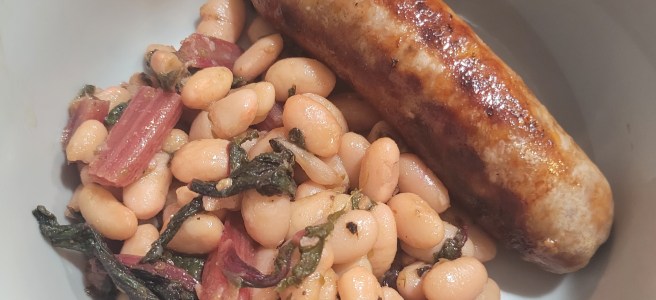
Welcome back to Gross Football Lunch!
This week’s installment features our first recipe that involves actual cooking! If network TV sitcoms have taught us anything, it’s that cooking is a mysterious altogether terrifying alchemical art, but fear not! Gross Football Lunch is here to guide you through this wilderness of general spookiness before diving into the Week 5 confidence pool. Let’s go!
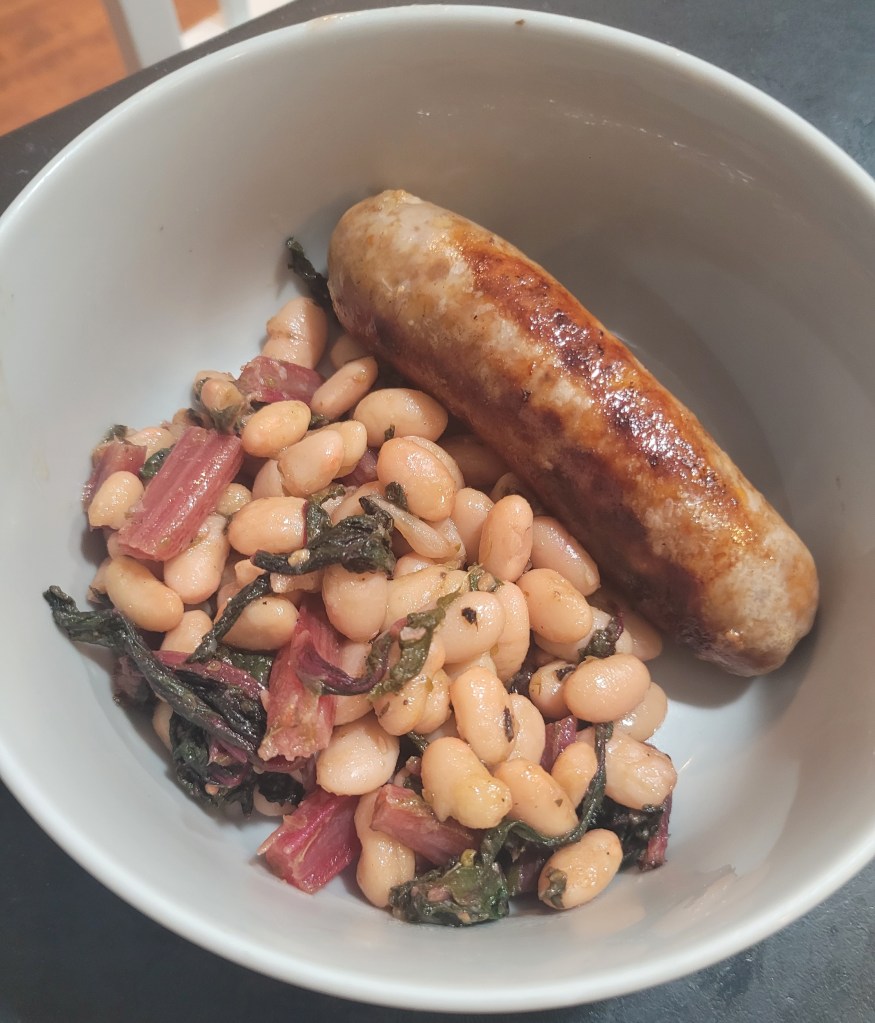
Recipe of the Week: Sausage, Beans, & Swiss Chard
It’s time to get cooking (in a non-Russell Wilson adjacent way)! Whereas throwing together last week’s Italian sub required no implements whatsoever (except maybe a bread knife), please note that in order to prepare this recipe you will need at least one thing you can credibly describe as a frying pan! Pretty much anything that fits that bill will do the job here, be it a cast iron skillet or a saute pan or your honest, dependable, long-suffering, and battle-tested non-stick pan. The only possible exception is a saucepan, which typically has a smaller surface area; you will want your pan to have as large a surface area as you can manage. You will also need some sort of cooking knife, unless you want to pull garlic cloves into thin, even slices with your bare hands. If you do pull your garlic into thin, even slices with your bare hands, please send me video, because that’s amazing!
Ingredients:
- Italian sausage links (1-2 per person)
- Swiss chard (0.5-1 bunches per person)
- Garlic (3-4 cloves per bunch of Swiss chard)
- Canned Great Northern or other white beans (1 can per bunch of Swiss chard)
- Olive Oil
- Lemon
- Salt
- Pepper
- Dried Italian seasoning
- Crushed red pepper (optional)
- Parmesan cheese (optional)
- Fresh parsley (optional)
Method & Analysis:
Let’s face it, sometimes in life you find yourself eating a meal that is best described as a pile. A pile is any meal that, rather than presenting as discrete mains and sides, instead presents as a giant swirling mass of components thrown together on a plate or in a bowl such that the entire meal gives the impression of being a singular, unified substance, even though it is anything but. That’s the best semantic definition I can come up with after a few minutes of moderate thought on the subject, and I can already tell I didn’t do a great job. The above definition leaves all sorts of wiggle room for a ton of dishes to crawl through. That’s not how piles work, though. Piles are a vibe, and they’re one of the most instantly recognizable vibes in all of human experience. Never will you ever eat a pile with a single shred of doubt as to whether it counts as a pile or not, regardless of whether you’ve spent any amount of time examining the concept.
At the risk of throwing out a statement that says more about me than it says about our shared human condition, a key component of the pile vibe is that piles are disreputable. They are meals that have been thrown together for one reason or another, seemingly without much thought. Hell, I’ve taken the term ‘pile’ from Patton Oswalt’s bit about KFC Famous Bowls, a bit so well known to me that it’s one of the last things my brain will replay before I die. Everything Oswalt describes in the bit scratches at a key reason why piles are easy to look down upon. They seem to exist for no other reason that to give their consumer the largest quantity and greatest variety of stuff in the most efficient package, with or without regard to quality. Piles are guilty pleasures at best and grim reflections of modern life and its many indignities at worst.
This bit rules and I will always love it, but you musn’t take it seriously. Because of this bit, I spent years and years looking down on piles, generally. You must not repeat my mistake! Piles can be good! A good pile is purposeful, using its inherent variety and efficiency in service of providing a meal that is easy and satisfying instead of furthering yet another dreary late capitalist evil. A good pile is fun, tasty, and vibrant. This week’s Gross Football Lunch is absolutely, unashamedly, 100% a pile, but it’s also everything a good pile should be. Come along, it’s time to reject our snootier impulses and make a pile worthy of praise!
Cooking prep work sucks, but to me, the only thing that sucks more than doing cooking prep work is doing prep work while you’re also in the middle of actually cooking other things. Therefore, I always do as much prep work in advance as possible, and I encourage you to do likewise. Place your bunches of Swiss chard on a cutting board, then chop off and discard the woodiest ends of the stems. Take the rest over to the sink and rinse of your chard to the very absolute best of your ability, making sure to give direct attention to any immediately visible clumps of dirt and/or crud. This will typically require several seconds under the tap; if you have a faucet with a spray function, now is an excellent time to use it. Once you’re done rinsing, shake excess water off the leaves but do not dry them. Take them back to the cutting board, and cut the chard into medium-sized strips. Each strip will look like more than a mouthful, but you have my personal assurance that they will shrink substantially during cooking.
Next, open and drain however many cans of beans you are using, then dump your beans in a strainer and rinse off all the excess bean can goop. White beans are one of life’s most unsung pleasures, but that gunk is nasty and will muck up the final pile, so you must get rid of it. If you don’t have a strainer, here’s what to do. First, open the can just a little bit, so that the water inside can escape somewhat efficiently but the beans will be harder pressed to escape, then drain the can into the sink. Once that’s done, use the tap to refill the can with water, then drain again; repeat this step until the goop is gone.
We’re almost done with prep! Gather up one lemon’s worth of juice in a small container and set it aside; this approximately 1-2 tablespoons of juice. You may also use an equivalent amount of white wine vinegar or sherry vinegar, if you wish. Gross Football Lunch does not and cannot in good conscience recommend using any kind of pre-packaged lemon juice, but it that’s all you’ve got so be it. Finally, peel your garlic cloves and thinly slice (or mince) each clove. There are many ways to peel a garlic clove, all of which are a bit tedious. That said, my personal favorite method is smashing the clove open. Hold your cooking knife parallel to your cutting board, with the clove between the knife and the board. Make a fist in your free hand and give the flat of the knife blade a good whack with it; this will bash the paper open, making the clove relatively easy to extract (although some paper may remain stuck to the clove; you’ll need to peel it off if so).
Now it’s time to start actual cooking! Start with your Italian sausage links. Place your pan on medium heat and add your sausages to the pan. Often times, pan cooking requires waiting until the pan itself has been on the heat long enough to become hot to the touch. The good news is this really isn’t one of those times. You can put the sausages on immediately or wait for the pan to heat fully, it really doesn’t matter. Turn your sausages periodically but not constantly; you want as many sides of your links to get that nice, deep, dark brown color on them as possible, and that requires patience. Don’t worry too much about burning the sausages, either. If they get blackened in spots they’ll still be perfectly tasty. Just turn them every few minutes and all will be well.
Your sausages are done when cooked to an internal temperature of 155 degrees Fahrenheit; this will take 15-20 minutes, give or take. If you have a meat thermometer, check in the middle of each link. Do not poke your thermometer all the way through each link, rather, stop when it is about halfway through to the bottom. If you don’t have a thermometer, cut each link and half and take a look. Your sausages are cooked when the insides are brown all the way through and uniform in texture; some light pink in the very center is ok. Desirable, even.
If you have more than one pan, congratulations! You will be able to start cooking everything else while the sausages cook. If not, wait on the following steps until after the sausages are done. Put your pan on medium-high heat and add enough olive oil to coat the bottom. If you’re using the same pan you cooked the sausages in, use the fat that cooked out of the sausages and maybe a splash or so of oil. This very much is one of those times when you want the pan to get hot before adding other things, so wait until the oil in the pan is hot (it will shimmer and become less viscous), then add the garlic and stir it around for a bit.
After 30 to 60 seconds, the garlic will become fragrant and start browning around the edges. Now is the time to add your chard. Dump it into the pan, and add salt and pepper, sprinkling it over the chard so that you have good coverage but no standing piles of either, and stir to combine. Avoid adding too much salt, here. The chard will start shrinking almost instantly, and will cook down to almost nothing in short order; this means that you need less salt than you’d think. As the chard cooks down, it will also release a large amount of water. Keep stirring the chard until this water evaporates; this will take about six minutes.
We’re almost done! Once the chard water has cooked off, bump the heat back down to medium, then add your beans, lemon juice, a generous sprinkle of dried Italian seasoning, and an extra dusting of salt and pepper. Stir to combine with the chard and let everything hang out for two to three minutes, until the lemon juice has cooked off. If you cooked the sausages first, add them in as well so they can reheat a bit. Turn the heat off once all your liquid has evaporated and the beans and sausages are reasonably warm.
Time to serve! Grab a decent sized bowl and plop a sausage link in it, then add a couple big heaps of beans and chard. Top with crushed red pepper, Parmesan cheese (either the real stuff or the stuff in a green shaker can, whatever you’ve got) and some chopped fresh parsley, if you can be bothered to chop up parsley (full disclosure: I usually can’t). This also makes tremendous leftovers, so if you can’t be arsed to do any of this on a lazy Sunday morning, consider making it a day or two in advance and reheating before kickoff. Dig in!
Week 5 NFL Confidence Pool
Oh no. Oh dear. Oh goodness gracious me.
This will not do, not at all. Eight correct picks out of sixteen games is disgraceful, and worse yet, these whiffs cost me an astronomical 59 points. In football, there is a school of thought that says after a terrible loss, the best thing to do is burn the tape and start fresh. I reject this idea on the strongest possible terms. There is always something to learn from every loss, especially brutal and conclusive losses. Clearly, I have Dunning-Kruger’d myself yet again and I cannot let that stand. I have to do better, and in order to do better, I have to know what I’m doing wrong in the first place. Therefore, let’s examine what went wrong in Week 4, and see what insights we can salvage from this wreck:
- The Bengals are not alright! My belief in their inevitability was so strong that I put 14 entire points on them, and the only way my brain let me do so was through ignoring the obvious. They came into the week 1-2, for Pete’s sake! I shouldn’t have to remind myself not to put double-digits on losing teams, and yet, here we are. They have one win against a respectable opponent, and nothing else. Burrow is hurt and the defense is a shambles. There was also a hefty portion of Titans disrespect baked into this point assignment, as I’m now on my fourth season of waiting for them to fall straight into the toilet. Perhaps I need to stop holding my breath on that.
- The Steelers do not deserve double-digit points, and won’t get them going forward. Old habits die hard. When I think of the Steelers, I think of their legacy of general competence, which in turn gets me thinking of their many past seasons of real contention. Put another way, I can’t stop staring at their damn pinstripes. (I know they don’t have pinstripes on their uniforms but you get the point.)
- If the Steelers blinded me with previous seasons’ glories, then the Dolphins blinded me with current seasons’ glories. I tend to use my 10 points as a Both of These Teams are Good But Who Knows assignment, so this could’ve been worse. That said, every point matters, so I take this as a good reminder that every game is different, and a 70-burger one week doesn’t guarantee victory in the next.
- The Lions are, in fact, good now, and I can trust them to a point. Conversely, their eternal toilet crew buddies the Browns cannot be trusted one bit.
These are enough actionable lessons for me, for now. Examining each and every missed pick requires more time than I have, and Week 5 features some very juicy mismatches I can use to get back on track. To the picks!
Week 4 Correct Picks: 8/16 (0.500)
Season Total Correct Picks: 56/64 (0.875)
Week 4 Points: 77/136 (0.566)
Season Total Points: 485/544 (0.892)
Bye: Browns, Chargers, Seahawks, Buccaneers
14 Points: Dolphins over Giants
13 Points: Lions over Panthers
I think it’s a mistake to view the NFL through the lens of Vast Superiority. Even the league’s clipboard holders, healthy scratches, and career special teamers can count themselves among the finest football players in the world. Therefore, while observable disparities in team quality are very real, they are also much, much smaller than they appear. When I use the term mismatches, I do so in the most relative sense possible, and with the understanding that I could be misreading the situation or misinformed, or both. Upsets happen, and if enough people saw them coming, they wouldn’t be upsets.
Keeping this in mind, I hereby declare that the Giants are puke and the Panthers are trash, and both are clearly outmatched against vastly superior opposition. Take as many points against them as your pool’s organizer will allow.
12 Points: 49ers over Cowboys
11 Points: Chiefs over Vikings
10 Points: Bills* over Jaguars
9 Points: Commanders over Bears
Here we see an object example of a classic confidence pool conundrum. Yes, the Bears are so bad that any respectable opponent constitutes a mismatch, but the Commanders are just this side of respectable. But picking the Bears is madness, so should I give the Commanders more points than I otherwise would? I say the answer is no. I simply cannot justify giving Washington double digits. They aren’t vastly superior than the lowly Bears, even in relative terms. Furthermore, this is the Thursday game, which means the potential for chaos is as high as it gets.
8 Points: Eagles over Rams
7 Points: Ravens over Steelers
6 Points: Packers over Raiders
5 Points: Patriots over Saints
4 Points: Titans over Colts
3 Points: Texans over Falcons
2 Points: Jets over Broncos
Is two points on the Jets too many? Perhaps it is against most opponents, but ask yourself this: What are the Broncos good at? The Jets still have their defense, do the Broncos even have a single particularly good position group? Think on this and get back to me, I’ll wait.
1 Point: Cardinals over Bengals
Is this disrespectful to the Bengals? Yes, without question. Is this an overreaction to putting 14 on the Bengals last week and missing? Also yes, also without question. But the Cardinals have way, way more fight in them than anyone thought possible, and the Bengals have no fight whatsoever. What’s strange is that’s probably a good thing; the Bengals need to have less fight right now, for Burrow’s sake.
Enjoy the games, everyone!

 Rob Writes About Whatever
One thought on “Gross Football Lunch – NFL Week 5, 2023”