

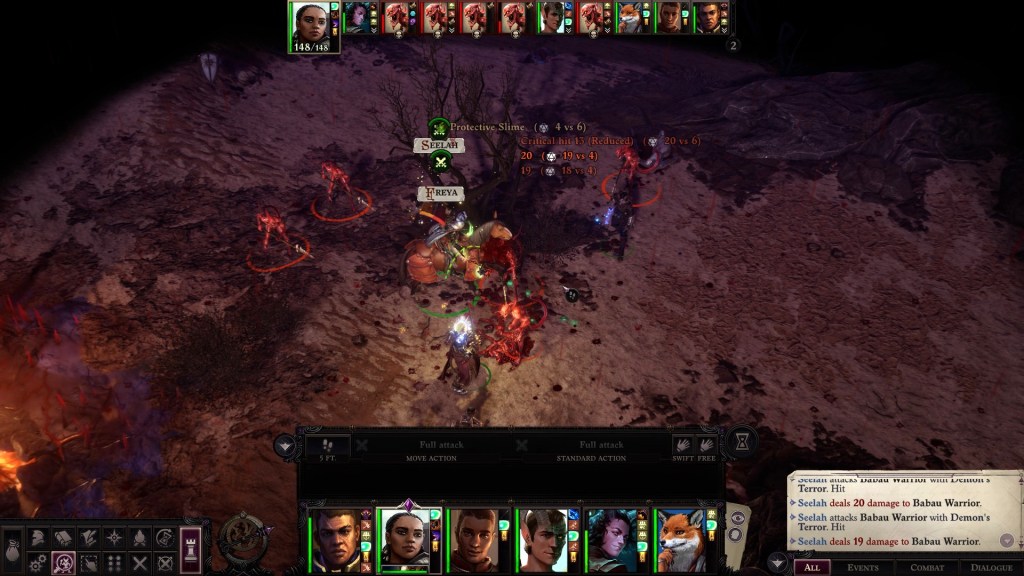
Welcome back to CRPG Corner! Before I get to the business of reviewing Pathfinder: Wrath of the Righteous, a brief recap is on order:
I bought Pathfinder: Kingmaker in the summer of 2021, and played it for about 45 hours. I liked it at first, as it seemed to have a lot going for it at first blush. Kingmaker is exceptionally gorgeous for a mid-budget indie game, the UI and menus do a good job of wrangling the unwieldy Pathfinder rules system into something resembling accessibility, and I appreciated the way the game made me put in real work to succeed, even though I did experience a lot of early game frustration. It kindled warm and fuzzy memories of the fussy shareware RPGs of my youth (shout-outs to Realmz).
But the main reason I liked Kingmaker at first was because I wanted to like it very, very badly. Over the course of a few whirlwind days of playing as much Kingmaker as I possibly could, I went from trying really hard to have fun to actually having some fun to having absolutely no fun with the game, whatsoever. My frustrations in the early going turned out to be a bad omen; Kingmaker is an incoherently designed game that attempts far too much and accomplishes far too little, while managing to be a complete pain the ass the whole way through. Here is an incomplete list of the game’s most flagrant sins:
- There aren’t enough quests! Most CRPGs have, if anything, the opposite problem. You’re either on rails for a significant portion of the early game, or you’re given an overwhelming surplus of things to do within minutes, or both. Kingmaker not only subverts this by giving the player a mere two or three quests at a time, it goes even further by guaranteeing that at least one of those quests will be too difficult to attempt before gaining a few levels and acquiring better gear; this is a simple proposition rendered baffling by the fact that you don’t have stuff to do in the first place!
- Exploration is frequently punished! Kingmaker does feature a gigantic overworld to explore; in a well-designed game, this would give the player ample opportunities to keep themselves occupied, thus justifying a relative dearth of assigned quests. Instead, this overworld gives the player a chance to waste time wandering aimlessly between sparsely placed areas of interest – many of which don’t even exist until the player has met maddeningly specific conditions – that are likely to be populated with brutally difficult if not impossible encounters (hold this thought). On top of that, there are hard in-game time limits on the game’s main story quests, which is a nice idea in theory but not when getting between any two points on the overworld is likely to take multiple in-game days.
- The difficulty balancing is atrocious! Like I said, combat encounters come in two varieties: incredibly difficult and effectively impossible. In order to progress in the game at all after the prologue, you will have to knuckle under and scrape your way through frustrating battle after frustrating battle. Expect to save scum like you’ve never save scummed before; not even good preparation can guarantee success. And good luck sniffing out an impossible battle in advance, since the success or failure of enemy examination is subject to RNG.
- Recruiting a full party takes too long! In Kingmaker, a full party is comprised of six members, including the player character. Recruitable party members are discovered very, very slowly over the course of Act 1, making the early game even more unforgiving. You can create additional party members, but only at a prohibitively expensive price. And the party members that do become available cover a shockingly narrow set of potential party roles. Which means…
- Only a small handful of main character builds are viable! I chose to main as a cleric only to discover that, of the small handful of recruitable party members out there, two of them are also clerics! I cannot fathom choosing to develop a video game based on 1st Edition Pathfinder rules – a system defined by the incomprehensibly vast suite of build options available to player characters – only to paint the player into a corner this way. If you don’t choose to main as an arcane spellcaster or martial DPS specialist, you’re going to have a bad time.
I need to stop myself here and move on, because I could dump on Kingmaker endlessly if given the opportunity, and I’ve already dedicated an entire post to doing so.
So, if I hated Pathfinder: Kingmaker so much, whatever possessed me to give Pathfinder: Wrath of the Righteous a shot? Both games were developed by Owlcat Games, both games are based on the often baffling and archaic Pathfinder 1st edition rules, and both games staple an optional but massive grand strategy game onto their preexisting and already massive party-based, story-driven RPGs. How could I possibly believe that Wrath of the Righteous would prove to be better than Kingmaker at all, let alone enough of an improvement that I would actually enjoy it?
Ultimately, I decided to give Wrath of the Righteous a try for two reasons. Kingmaker has a cult of dedicated enthusiasts, some of whom found my expression of distaste for it and then reached out to me wondering if I might give it another shot at some point. I started to whether I was being fair in my initial assessment of the game or not. Maybe my approach to the game was the problem, and if I changed my mindset and accepted the game on its own terms, I would see what others liked about it.
Second, and more importantly, I must re-emphasize that I was desperate to enjoy Kingmaker! Even after moving on from Pathfinder as a tabletop game, I still yearned for a Pathfinder video game of some kind, figuring that there was real fun potential in the system as long as a human being wasn’t in charge of keeping everything straight. Once Wrath of the Righteous was released in late 2021, I started gobbling up every professional and amateur review I could find, in an attempt to suss out whether or not it was a better game.
This proved inconclusive, so a couple of years ago, I reinstalled Kingmaker and gave it another shot. After another five hours with the game, I’m pleased to report that Kingmaker still sucks. Even when I went in knowing what to expect out of it, and with some ideas of what I could do differently in order to have fun, I found the game to be a dull chore. To this day, I have no idea what its’ partisans see in it, and I don’t suppose I ever will. Even the story blows!
But, I still yearned for a Pathfinder game that was good, and by that point there was another one out there. Since my efforts to determine whether or not I would like Wrath of the Righteous without playing it for myself proved futile, there was only one thing to do. One day, Steam recommended it to me at a deep discount, and in a moment of weakness, I pulled the trigger.
* * * * *
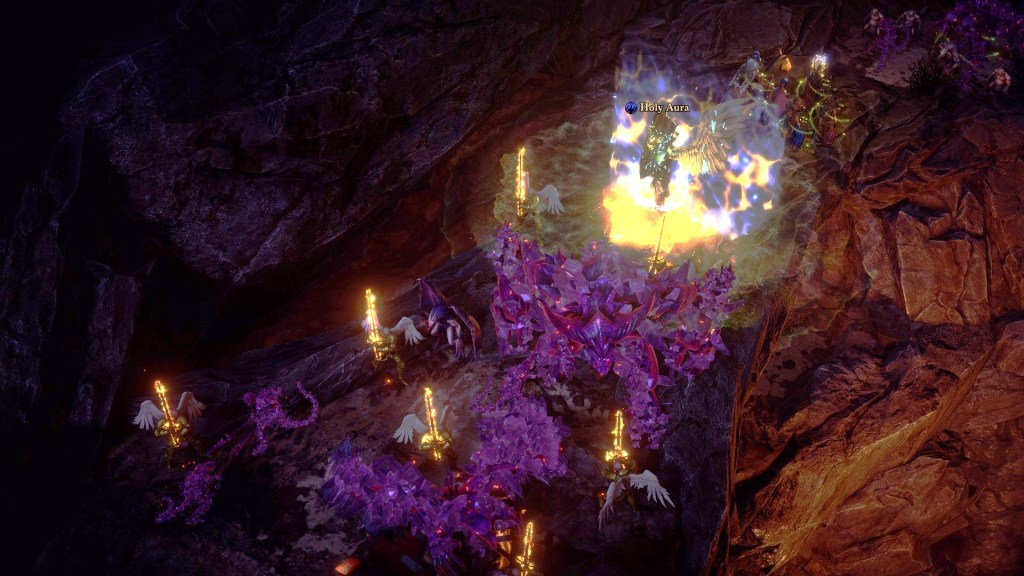
For once in my life, let me cut to the chase. Pathfinder: Wrath of the Righteous is a much, much better game than Kingmaker. It is nothing less than a very good CRPG, and in many ways, it is a great one. Wrath of the Righteous is more inviting, more immediate, and more pure fun than Kingmaker from the very beginning. The combat encounters are well designed and the early game difficulty is well paced. Normal fights are simple, and boss fights provide adequate challenge. It’s easy to find recruitable party members in the early going, and even before you’re able to fill a six character party, the party members you start with are versatile enough to fit around whatever main character build concept you choose. Once you complete the prologue, there are plenty of quests to do and plenty of opportunities to explore and gain access to even more quests. While many quests do have time limits, these time limits are tied to chapter progression, not in-game days, freeing the player to work on quests in their chosen order and at their chosen pace. In direct contrast to Kingmaker, the Wrath of the Righteous player will never want for things to do.
But the best part of Wrath of the Righteous is the writing. The story grabs the player by the throat from the jump and never lets go, thrusting them into the middle of a demonic invasion and tasking them with saving the starting city of Kenabres before going on the offensive into demon-controlled lands. The characters along for the ride – both friend and foe alike – are built with verisimilitude, even in the midst of a story and a setting that could not be more fantastical. They are all complex, grounded, and worth getting to know. The likeable characters are shaded with real flaws and the unlikeable characters have understandable motivations. Even many of the actual demons you will get to know over the course of the game are interesting in their own way.
Most impressively of all, Wrath of the Righteous does something very few video games are able to do with their stories. Many if not most story-driven video games hammer the player over the head with their emotional beats; they can’t help but tell the player how to feel. Wrath of the Righteous shows the player the costs of waging an all-out war against an endless demonic horde and lets them decide how to feel about their circumstances and their actions. When I played through the game, I felt the weight of my decisions and their consequences (and make no mistake, there will be consequences) organically as a result of playing the game, not as a result of sitting through cutscenes that explained how sad my main character is.
Wrath of the Righteous is an incredible achievement, and it proved to be the Pathfinder game I always wanted. I could not stop playing it for a long, long time after I started, and during that period it quickly shot up the list of my favorite video games of all time. It kicks ass, it really does.
But! There’s always at least one but, isn’t there? No video game is perfect – even Baldur’s Gate 3 has its issues – and Wrath of the Righteous is no exception. Wrath of the Righteous has its flaws. Really, it has lots of flaws. This game has so, so many flaws. Just so very many flaws. I don’t even know where to begin in describing this game’s many, many, many flaws. Once my honeymoon period with the game ended, I found myself running up against petty gripes that turned into serious complaints that turned into questions of whether or not I could even be bothered to finish the main campaign. I did ultimately power through to the end, but suffice to say, by the time I was done this game did not maintain any position on my all-time list. So what went wrong, exactly?

Simply put, Wrath of the Righteous is entirely too goddamn long. The main campaign took me approximately 275 hours of playtime to finish. Granted, I played my way through the game slowly by choice; in Wrath of the Righteous, the player can choose whether combat will run in real time with pause mode or turn-based mode. I played the entire game in turn-based mode, as I have a strongly held conviction that real time with pause is inappropriate for the Pathfinder combat system. The action economy is too specific and the tactical options available within that action economy are too varied. If turn-based combat hadn’t been an option, I wouldn’t have been interested in the game in the first place. I also played through Crusader Mode, the game’s entirely optional grand strategy component, in its entirety.
Still, 275 hours is an unthinkable amount of time to spend on a single playthrough of any game in any genre. Mind you, I am not and have never been a completionist, and while I did finish most every quest presented to me over the course of the campaign, I certainly didn’t finish all of them. How could I possibly want to? If no video game is perfect, some of the game’s problems are going to be apparent after 27.5 hours of play. After ten times that amount, problems were just about all I could see.
Here’s the dirty secret of Dungeons & Dragons: high level play isn’t all that fun. It never has been, and it never will be. While the prospect of fighting high level monsters and apocalyptic-level threats can be enticing, the reality is that eventually, there comes a point where every challenge and combat encounter that can be thrown at the party is either an unspeakable pain in the ass or a pathetically easy waste of time. This is as true of AD&D 1st edition as is is of non-advanced D&D 5th edition; the only difference between editions in this respect is at what level this point comes. (Suffice to say, there’s a reason Baldur’s Gate 3 sets its level cap at 12.)
Pathfinder 1st edition is, of course, directly derived from D&D 3.5, and therefore has the same problem. Really, Pathfinder has the very worst version of this problem, since each and every single level up is a massive improvement for player characters and party members. Wrath of the Righteous takes this one step further through the addition of Mythic classes. Mythic classes provide the player character with a vast suite of incredibly impressive special abilities to choose, and the player’s party members also gain some of these benefits, too. Unlike character classes, in which levels are gained through gaining experience points, mythic levels are gained at specific milestones in the story. Over the course of the game, the player will gain 20 levels in their character classes and 10 levels in their Mythic class; this means both the main character and the rest of the party become absurdly, unspeakably powerful, even by the standards of level advancement in other RPGs. Of course, this also means that, in order for late game enemies to pose any challenge whatsoever, they too must have obnoxiously high stats and absurd abilities of their own.
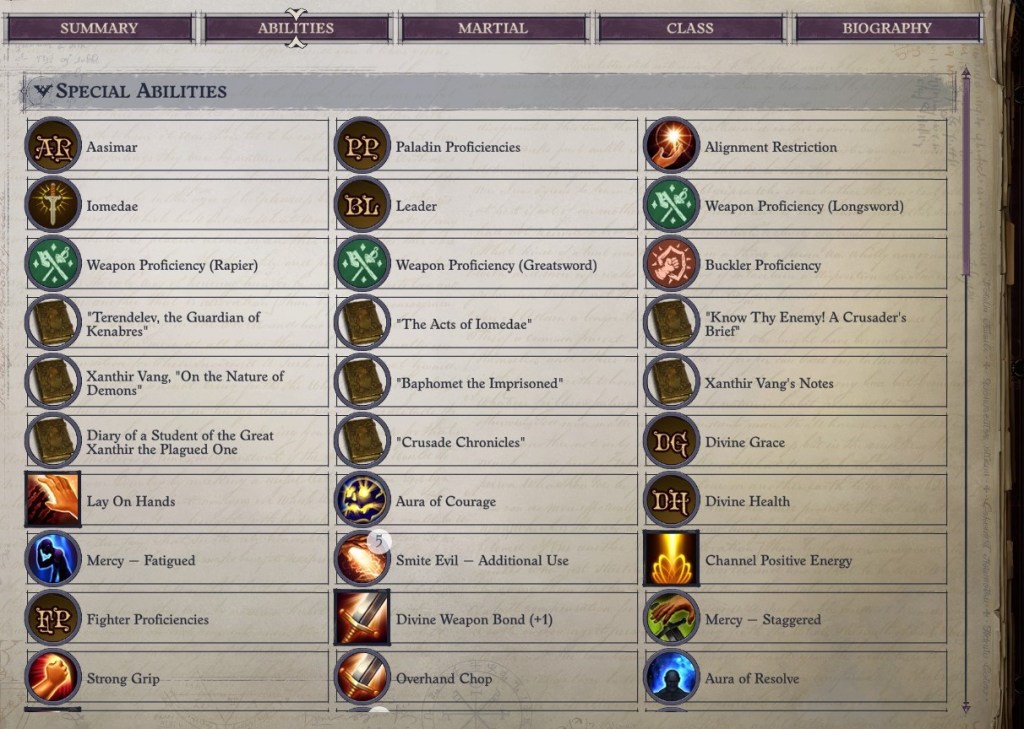
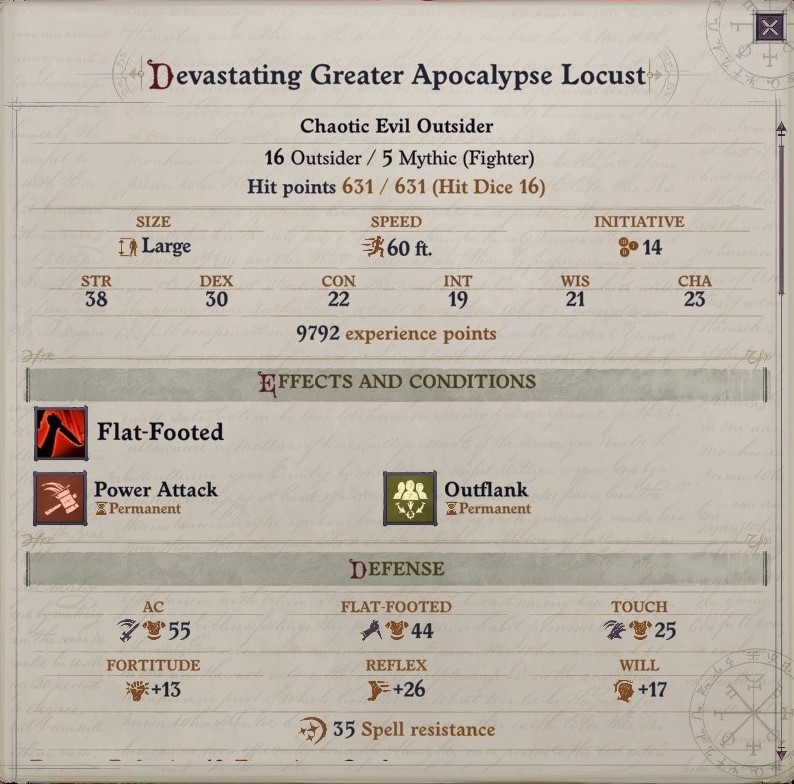
Wrath of the Righteous is split into five chapters. I hit character level 15 at the very end of chapter three and I hit mythic level 5 shortly thereafter; this proved to be the exact moment the game could not longer hit the sweet spot between too hard and too easy. My play sessions took on a certain numbing quality, as they were almost all spent snapping back and forth between mindless clicking and sitting slack-jawed, wondering how in the heck I was supposed to defeat enemies with Armor Class values in the 50s (or higher), saving throw bonuses in the 20s (or higher), and laundry lists of status immunities and non-conventional defenses. In its later portions, Wrath of the Righteous became particularly fond of giving enemies concealment, a condition that gives any incoming attack an automatic miss chance, before the attack itself is even rolled. Hold this thought.
The frequent, wild swings in difficulty left me mentally exhausted, and all of a sudden, all of the minor problems I had run into up to that point became much, much harder to ignore. Oh jeez, it appears I neglected to discuss these issues with any specificity, so perhaps it’s time to fix that, no? For starters, while Wrath of the Righteous does correct a lot of Kingmaker’s basic gameplay issues – you can rotate the camera, and enemy inspection is no longer subject to RNG – it doesn’t fix all of them, and it has some of its own problems, to boot.
I still could never tell when two or more party members were considered adjacent, nor could I tell when two or more party members were flanking an enemy. Sometimes I would attempt to move a character before taking an action, only to find that they scooted forward a teeny tiny bit, and somehow used their entire turn to do so. Quest advancement can still require bafflingly specific conditions to be met; in particular, I remember a fetch quest that required me to find 20 particular items – fetch quests are boring enough, but 20-item fetch quests are beyond the pale – and didn’t allow for partial success. I had to find all 20 items to turn in any items to the quest giver, which is outrageous.
Also, while Wrath of the Righteous does do a much better job of accommodating different play styles than Kingmaker, it doesn’t do a perfect job by any means. A small handful of combat encounters all but required preparing specific spells, which occasionally forced me to backtrack when I rolled up without those spells prepared. If there was a way to know what spells I needed in advance, I missed it. While there were only a couple of occasions in which my main character was forced to enter an area alone, that remains one of my pet peeves and I am thus honor-bound to call them out. I was also given a vast, vast amount of potions and scrolls that I couldn’t even invent a use for, nor imagine their potential utility for other character builds. Why am I getting so many Protection From Law potions? I’m fighting demons pretty much exclusively, and all demons are chaotic!
I would be remiss if I didn’t mention the puzzles. Wrath of the Righteous doesn’t have all that many puzzles in the scheme of things, but there are a fair amount of them, and let me tell ya, they are all garbage! I freely admit that puzzles aren’t always my thing, but at least when I’m confronted with a puzzle, I can usually determine what I’m being asked to solve. In Wrath of the Righteous, illegible puzzles were the rule and not the exception; when I did think I had determined what the solution was meant to be, based on the evidence available, I was often incorrect. I can recall at least one instance where the clue to a puzzle I was given was directly contradicted by the puzzle’s solution (no more than three in a straight my fat but somehow also bony ass!), and I can also recall a puzzle that seemed to assume I knew Abyssal numerals. Consider this a friendly reminder that, if you want to become a puzzle designer, you really should read some Wittgenstein first.
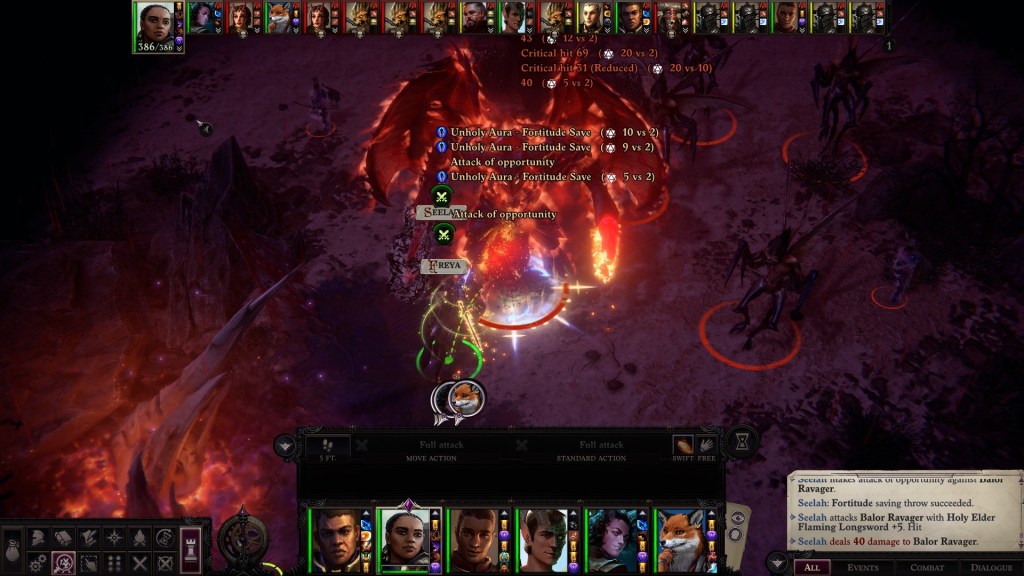
There’s also the matter of how Wrath of the Righteous tracks its own rules, and communicates Pathfinder rules to the player. One of the few things I did like about Kingmaker was the menu system, as it did a generally good job of laying out all of the information I needed to know about classes, items, spells, feats, and anything else that required explaining rules. Wrath of the Righteous uses the same menu system, and while these menus do a good job of explaining most Pathfinder rules, they don’t always explain all the relevant rules in every situation.
This was most noticeable when selecting feats. I’m trying my very best to avoid getting into the weeds of Pathfinder rules, but I’m not sure I can explain my beef with how Owlcat approached feats and hold firm to this policy at the same time, so bear with me. Feats are build options that are available to player characters when they reach certain levels; while characters of every class have access to feats, some feats have prerequisites. Some feats require a character to be a certain race, or have a certain amount of levels in a particular class. Some feats require the character to have a certain special ability, and most importantly, some require the character to have certain other feats. In these final cases, this means that taking a particular feat unlocks a whole tree of other feats. Also, note that each type of feat prerequisite is not exclusive; for example, it is fully possible that a particular feat will requires a character to reach a certain level in a certain class and have selected a specific prior feat.
The problem with the feat menus is that they don’t actually show the player these trees of feats; all the feats are always shown as an alphabetical list. This has a deleterious ripple effect on the player’s ability to make good decisions for their character and party member builds. Let me explain. No, there is too much, let me sum up: under Pathfinder rules, when a character levels up, they do not necessarily gain a level in their existing class. Rather, the player gets to choose what class the character will take a level in, with relatively few restrictions. Most builds benefit from multi-classing; I multi-classed every character that wasn’t a dedicated spell caster with access to 9th-level spells, and I may have been better off multi-classing some of them, too.
Since Wrath of the Righteous sets a hard level cap at 20, multi-classing requires advance planning. It is in your best interest to decide how many levels of which classes you will want to give each and every character as far in advance as possible, and in what order. Guess what? You can’t really do that if you don’t also have at least some idea of which feats you’ll want for each character, and you can’t really figure that out easily if you can’t refer to the actual feat trees.
This screwed up my main character’s build, even though I planned it out as thoroughly as I could as soon as I could. At level 20, my main character was a 17th-level paladin and a 3rd-level fighter; had I been able to scout the feat trees in advance, I would’ve known that since I took Weapon Focus (Greatsword), I would’ve been able to take Weapon Specialization (Greatsword) if and only if I also took a 4th level of fighter! In hindsight, my main character should have been Paladin 14/Fighter 6, but I could’ve known that in foresight if the feat trees were easily accessible. And, to be fair, I could have known this anyway if I had dusted off and cracked open my old Pathfinder 1st edition Core Rulebook, but I can’t help but feel that shouldn’t be necessary in this context.
All of these issues were noticeable but easy to ignore in the first three chapters of Wrath of the Righteous, but once the battles became more annoying, everything else did, too. The late game added another new, unexpected, and altogether delightful problem to deal with on top of all this, too. I’m not sure that Wrath of the Righteous was actually keeping its own rules straight. Buff spells and effects appeared to be either misapplied, or not applied at all. The game has a mechanism for telling the player when a character is benefiting from multiple effects that don’t stack (if you don’t know what that means, trust me, you don’t wanna know), but it didn’t always seem to work, and sometimes when it did work, it only flagged the item or spell granting the superior bonus. Checking the combat log for the saving throw DC of an enemy effect sometimes revealed a drastically different save DC than the one shown on the enemy’s examination card. Remember how I said this game was fond of giving enemies concealment in the late stages? Almost all concealment effects are countered with the True Seeing spell, and yet, even with True Seeing cast on the entire party, I still racked up lots of and lots of automatic misses due to concealment. What the hell!?
Now, do me a favor and read that last paragraph again. Notice anything? Pay attention to the language I’m using: “not sure”, “appeared to”, “didn’t always seem”. These are the words of someone who can’t tell what’s actually going on. Why am I complaining, then? What if Wrath of the Righteous handled the Pathfinder rules just fine and I just got confused? Because the confusion is the problem! The whole reason I wanted a Pathfinder video game is because I thought the system could still be fun as long as I didn’t have to keep track of all the rules, yet there came a point in Wrath of the Righteous where I became compelled to do just that. Call this a skill issue all you want; I put in as much work as I could to understand what was going on when I experienced rules confusion, and I didn’t find clear answers. That sucks!
* * * * *

I was hesitant to play Crusader Mode – Kingdom Mode was a big part of what made me sour on Kingmaker – but I chose to play it anyway, motivated by the same magnanimous spirit that moved me to give Wrath of the Righteous a shot in the first place. I’m told Crusader Mode plays more or less like a Heroes Of Might & Magic game. You raise armies to send into battle against armies of demons, you build, maintain, and defend bases, you complete special projects, and you make big picture strategic decisions.
Taken by itself, I was pleasantly surprised at how much fun I had with Crusader Mode. The battle system was easy to learn, yet difficult to master. Base management reminded me of the fun parts of Kingdom Mode. When it was time to make a mutually exclusive strategic decision, I felt I was given enough information to make an informed, wise choice, and I usually did (my tendency towards decision paralysis can make grand strategy gaming a stressful proposition). I also appreciated that Crusader Mode gave me something else to do when I felt the need to step away from the RPG side of things. It was nice to be able to make real progress in the game while also engaging my brain in a different way.
That said, Crusader Mode is ultimately inessential. Wrath of the Righteous entices the player to try Crusader Mode with the promise of items and other rewards the player can use in the RPG, but I found that almost none of these rewards were worth it. For starters, most of the rewards available in Crusader Mode are rewards for Crusader Mode. The RPG rewards I obtained weren’t worth much; magic items available through Crusader Mode were invariably either so specific in their benefits that no one in my party had use for them, effectively obsolete by the time they were obtained, or both. Eventually, you can build teleportation circles at crusader bases for your party to use (which is the only fast travel mechanic Wrath of the Righteous has to offer), but this is a luxury, not a necessity.
At the end of the day, I can’t help but be annoyed at Crusader Mode’s very existence, even though it was fun enough of its own merits. I am not so naive to believe that work hours spent developing Crusader Mode could have been directly reallocated to cleaning up the RPG’s jankier elements, but I also fail to see the wisdom in spending time and money on a robust secondary gameplay mode when the primary gameplay mode still needs this much work. The fact that Crusdaer Mode is entirely optional makes this even more baffling. Why even bother including what is effectively a second game when the player can simply ignore it without real consequence? Once again, I can’t help but scratch my head at Owlcat’s decision making, and I can’t help but view it as the consequence of blind, unchecked ambition.
* * * * *

So, with all of that out of the way, is Wrath of the Righteous worth playing? The answer is yes, albeit a heavily qualified yes. Once again, I must reiterate that the Pathfinder 1st edition rules are dense and impenetrable even by tabletop gaming standards. Wrath of the Righteous is work, but it does feature heavily customizable difficulty settings, so that you can effectively choose the amount of work you want to put in. I know I spent no small amount of words complaining about how much work this game can be at times, but make no mistake: I’m into that shit. I gave this game 275 hours of my life because I wanted to. If the thought of spending hours upon hours thinking through and mulling over build options, examining enemy statistics, and micromanaging equipment sounds unpalatable, start on Story mode and increase the difficulty if and only if you get bored.
If all of this work sounds like your idea of a good time but you are not familiar with Pathfinder 1st edition rules, don’t even think about starting your game on any difficulty setting higher than Casual. This rule set is dense and impenetrable, even by tabletop gaming standards. It is also unforgiving of poor decision making on even the moderate difficulty settings. In order to teach yourself the game’s rules, you will have to spend a lot of time either closely reading every tooltip and menu the game has to offer, or with your nose buried in any and all guides you can get your hands on. Once you feel you have a good grasp on the rules, feel free to increase the difficulty if you wish, but disable character retraining at your own peril.
If all of this work sounds fun to you and you are familiar with Pathfinder 1st edition rules, what do you need my advice for? You know what I’m talking about at least as much as I do, if not more so. You probably only sent me a click to check whether or not my opinions of the game reflect and/or validate yours. (And I appreciate you for it! Thank you!) You’ve probably already played through the game multiple times in order to sample a variety of Mythic paths, which is some real dedication. I liked Wrath of the Righteous plenty and I’m glad I played it, but I’m not sure I’m willing to sign up for any additional playthroughs just to try out some different abilities and sidequests. Hell, it’s possible that you’re so about the Pathfinder lifestyle that you thought Kingmaker was good, you sick little freak.
ANYway, Pathfinder: Wrath of the Righteous is a triumphant masterpiece that absolutely sucks out loud from time to time. Play it, but be patient with it. Go slowly, pay attention to details, and make sure you’re playing it on a difficulty setting that is right for you. Enable Crusader Mode if and only if it sounds like fun. If it doesn’t, don’t let the game pressure you into turning it on. You really won’t miss it, I promise.
Have fun, everybody!

 Rob Writes About Whatever
Great review, Rob. Enjoyed reading it. Glad I stumbled across your blog. I bought Kingmaker on Steam when it was on sale, but never played it. I knew the reviews were terrible but I’m an RPG junkie so I bought it anyways just to add it to my collection plus the digital art book that was included made it worth the price of admission even if I never play the game. I have WotR on my Wishlist and will pull the trigger when next it is on sale. I will purchase the Mythic edition for the soundtrack and digital art book. I will take your advice and play Story mode on the casual difficulty setting because I am not familiar with any edition of the Pathfinder rules. On another note, are you a fan of RPG board games? I stumbled across the HeroQuest board game and have really enjoyed it. Being able to play solo is a huge plus for me. If you haven’t tried it, I would highly recommend it.
Thanks again for taking the time to draft this review!
LikeLike
Thanks Justin! I’m glad you found the review useful, and I really appreciate your thoughts!
I have played a couple of RPG board games; I played Descent a handful of times and I also played Talisman once. I’m familiar with HeroQuest but I’ve never played it myself. They’re fun of their own merits and they have their place (your point about solo play is well-taken), but to me, they’re also so complex that putting together an actual TTRPG isn’t actually much less work, and I think that’s a real point against them.
LikeLike
Hey, Rob. Thanks for the response! I can see where you are coming from 100%. I guess for me there are two factors that make RPG board games attractive when compared to the digital experience. First, it is an opportunity for direct social interaction with friends/family. Second, I’m a huge fan of lore/story and some board games do not have a digital counterpart. HeroQuest is one such example. Like you, I am not a fan of a long set up time. I want to dig in ASAP. Your reference to Descent is a good example of a board game that has a lengthy set up time. All the cardboard sheets of board pieces that have to be removed and built, etc. But even then, some people enjoy that part of the board game experience. With HeroQuest, for example, there is an entire community of people who share ideas and tricks on how to paint the board pieces. It is amazing to see what some people can do with a hunk of plastic! Anyways, HeroQuest doesn’t have a lengthy set up time or learning curve to it like some other games in the genre (Descent, Gloomhaven, Frosthaven, etc) which is nice. Plus they have several expansions with endless replayability.
Bringing things back to the topic of your article, Steam just announced another sale on WotR so I am going to snag it and give it a try. I will circle back and let you know my thoughts. Thanks again for the great review!
LikeLike
i’m in the act 4 of the game currently and (out of growing frustration) i just started googling random thoughts about wotr, so that’s how i found your review.
thank you so much for your write-up, it’s the only one i managed to find that actually resonated almost fully with how i feel about this game. yes, the devs reliance on absurdly high AC and SR, concealment and swarms gets REALLY tiring, especially considering how enormous the campaign is, but it’s also equally important just how awesome and fun and epic it is at times. and i definitely needed a good reminder of the latter.
one small correction though: there is a toggle in the settings that will stop your characters after they run out of movement points in their turn, essentially preventing you from accidentally using your action for bonus movement. im not sure why that isnt the default…
cheers!
LikeLike
Thank you, I’m glad you liked the post! It means a lot to know that there are people out there who were looking for exactly what I was trying to provide with my review; it is not an easy game to assess, and I wanted to let people know exactly what to expect. Thanks!
Didn’t find the movement setting you’re describing but that’s good to know. I agree that it should be the default though, and I’d further point out that this kinds of oversights are exactly why I find Owlcat’s work frustrating. Seriously, how do you not think of that!?
LikeLike
I agree, I have a busy work schedule and I started to play this game but after 20 hours or so, I find it to be so long I begin to forget what I was doing the week prior and now it just in my backlog… Really wanted to like it, but its way too long for a busy person.
LikeLike