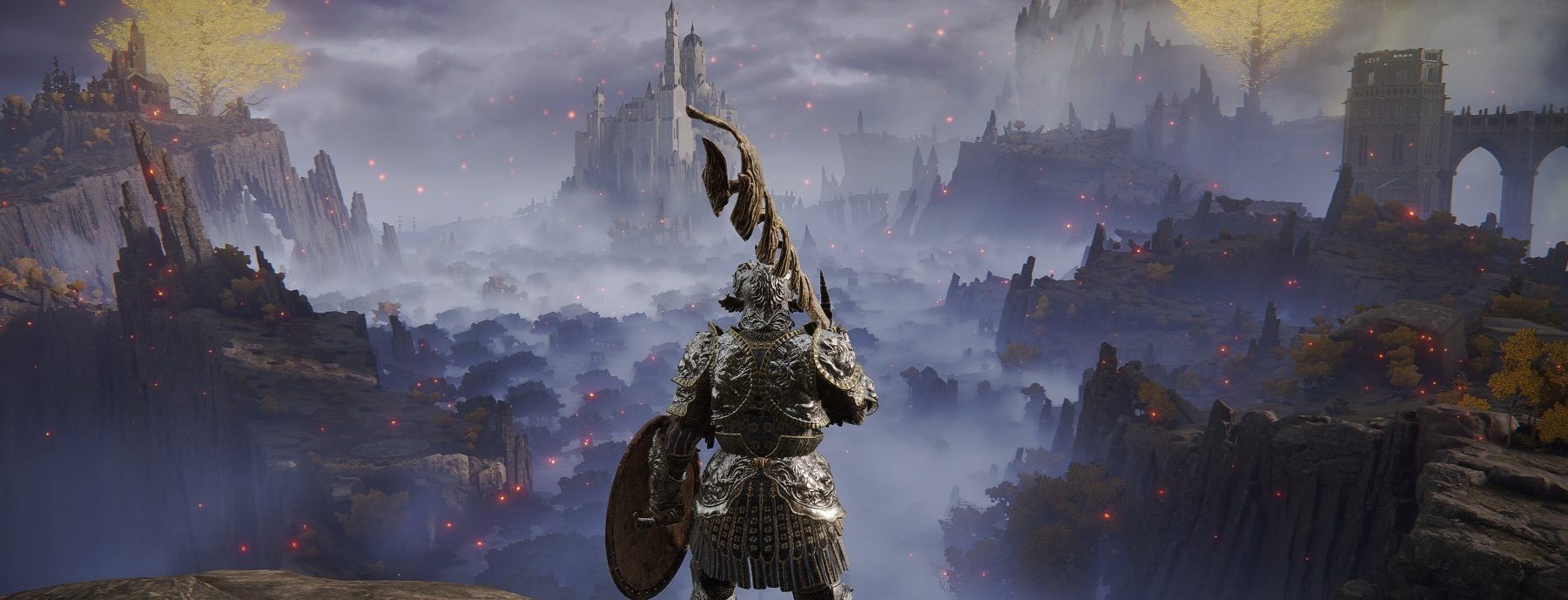
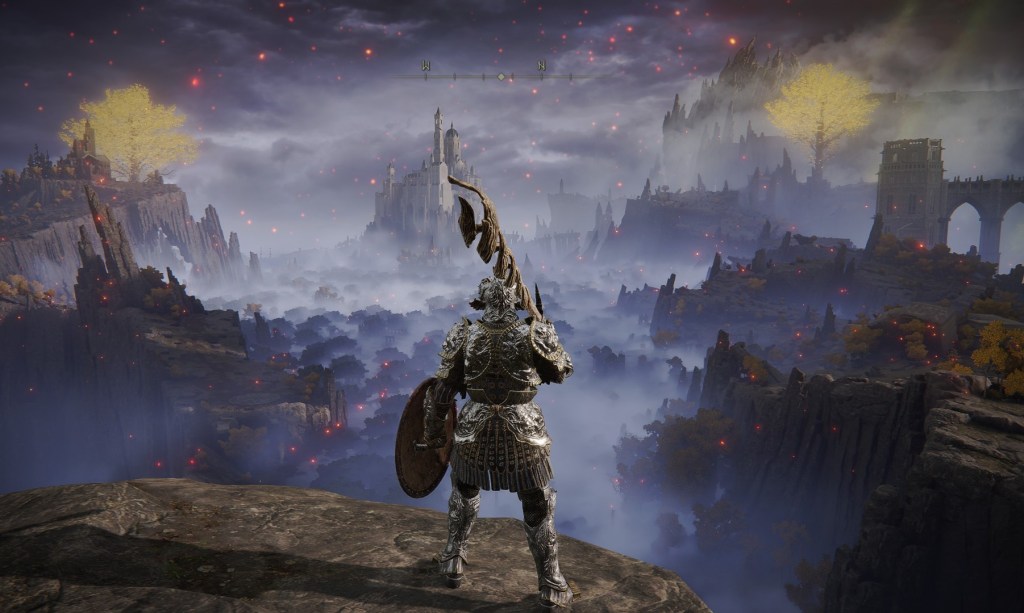
Did I ever tell y’all that I was working my way through Elden Ring? Because I was, in fact, working my way through Elden Ring up until very recently. After 11 months and almost 170 hours of playtime, I have finally finished it, so now I’m full of opinions about it that I can’t wait to blather on about. But, unfortunately, those opinions are going to have a wait a little bit while I go on an extended tangent…
Did I ever tell y’all about the time I played Dark Souls? Because I did, in fact, play Dark Souls a couple of years ago, and I don’t think any of my thoughts about Elden Ring will make a lick of sense without the context of my Dark Souls experience. So I will also have to share my rambling, discursive thoughts on Dark Souls in this space in order to contextualize my rambling, discursive thoughts on Elden Ring, which means this post is about both Elden Ring and Dark Souls. I simply couldn’t figure out a way to blather on about one without blathering on about the other. You’re very welcome, and I’m terribly sorry.
I think that I had a typical Dark Souls experience, in that I alternated between believing it to be the greatest video game ever created and absolutely loathing everything about it. Dark Souls is a game designed to break the player down and build them back up, over and over and over again, in ways both big and small. This dynamic is at the heart of the game’s reputation; while its rewards are great in both quantity and quality, it is also a demanding game, both mechanically and emotionally.
The mechanical demands weren’t so bad; I’m no stranger to tough video games. But as I progressed towards the mid-game, the emotional demands began to take a serious toll. I began to feel more and more as though I were playing the game the wrong way. My one-dimensional play style – smack enemies as hard as possible with the biggest melee weapon available – became even more one-dimensional over time, which meant my one-dimensional build became even more one-dimensional over time, which meant that as I advanced, I started skipping more and more optional areas. I became unwilling to learn how to play differently when the situation called for it, and therefore unwilling to play more of the game for its own sake. This sense of wrongness was what led me to my lowest depths of frustration. It’s one thing to die constantly; it’s another to die constantly, fail to adapt, and internalize that failure as a form of personal guilt, albeit a low-stakes one.
Did I mention how parenting-unfriendly this game is? When I started Dark Souls, my firstborn was not even four months old, and babies have something of a reputation for being fussy, high-maintenance types. You can play video games and take good care of an infant, but you must be able to stop playing at a moment’s notice, and that’s pretty damn difficult when you’re playing a game that doesn’t let you pause. Furthermore, it’s possible to play Dark Souls for hours without making any real progress. This is well and good when your circumstances can accommodate playing for hours at a stretch, but I found that when I was sneaking in whatever Dark Souls I could, it was fully possible I would emerge from a 30-minute play session having died a bunch with nothing to show for it, which meant that my chosen leisure activity left me cranky and stressed out instead of refreshed. This happened countless times, and it sucked every time.
The net effect of simultaneously navigating the struggles of both Dark Souls itself and life as a new parent who is also trying to play Dark Souls was that, while I loved the game dearly, I also needed to step away from it for weeks and even months at a stretch. At one point, I had stopped playing the game for five entire months, and I’m not ashamed to admit that during this period I doubted I would ever go back and beat it. When you’re a parent, every decision you make regarding how to spend your limited free time is a business decision; when viewed through this lens, any decision to play Dark Souls was an inherently risky one. I had tried Dark Souls for myself, and I had found it fun but also too much, and I started to think maybe that was good enough. When I chose to step away, I do so because I felt my life was difficult enough, and I didn’t need to make it harder on myself by risking massive windups during my downtime.
After a while, I had mostly made my peace with the idea of leaving Dark Souls unfinished. Mostly. But after those five months, I changed my mind; the game was simply too much fun when it was fun for me to say goodbye forever without giving it another shot. I returned, I persevered, and ultimately, I triumphed. I still skipped a whole bunch of stuff, but I saw it through and felt like a million bucks for having done so, and I will cherish that memory for the rest of my days.
So anyway, Elden Ring. Elden Ring is more or less an open-world version of Dark Souls. The combat and combat mechanics are broadly similar, and are best summarized as a third-person fantasy action RPG. You explore vast, gorgeous areas, you fight enemies of all kinds (and I must note that both games place a particular emphasis on boss battles), you gain resources that allow you upgrade your levels and equipment. The main difference in the core gameplay loop between the two games is strcutural. Dark Souls is often a surprisingly linear game. While there are plenty of optional areas to explore, and the player does occasionally have some freedom to choose what area(s) to tackle next, Dark Souls is often akin to the traditional Metroidvania experience, where finishing one area opens up the next (or, more accurately, the next set of areas). By contrast, the open-world structure of Elden Ring both broadens the possibilities of exploration and gives the struggling player greater freedom to leave the area that’s troubling them and come back later, if and when they choose to. Elden Ring also features shockingly few truly mandatory areas, although most players will typically choose to explore as much as they can.
But, in both games, you must Git Gud. Gaining levels makes things easier, as does obtaining better weapons and equipment, but these things alone are not sufficient to progress through either game. You must Git Gud. Dark Souls and Elden Ring force the player to engage in frequent combat with a variety of enemies, each of which has a variety of attacks and combos. Learning the tells for each attack teaches the player how to defend against each attack, which teaches the player when an enemy is open to counterattack. While these lessons are being taught, the player will die, over and over and over again. The punishment for poorly timing defensive maneuvers is severe, and the windows to defend and counter are narrow. Mindless aggression will often leave the player wide open for being taught a painful and quite possibly fatal lesson. Death is a constant, but it is a constant teacher. Both games are tough, but they are also fair. You will always know exactly why you died, therefore, each death has a lesson to teach.
I know I’m describing this in maddeningly abstract terms, but I’m doing so for a reason. Dark Souls and Elden Ring give the player near-total freedom to develop both their character build and their preferred play style. Maybe you’ll attack primarily with magic and defend yourself with a shield; maybe you’ll attack primarily with ranged weapons and defend yourself with dodge rolling; maybe you’ll use a melee weapon and switch between using a shield and wielding the weapon with two hands. Maybe you’ll use some other combination of attacks and defenses entirely! Describing any specific fighting style can only illustrate that fighting style. It cannot provide anything remotely resembling a complete picture of what combat really is.
But this understanding points towards the beautiful truth of Getting Gud. The phrase is a reminder that players of Dark Souls and Elden Ring must always strive to get better, but it is also a mantra, a reminder that the first question the games pose to the player is a test of self-awareness: How do you like to play video games? After all, Gitting Gud is not simply overcoming the challenges both games throw at the player. It is also the process by which the player determines and refines their own preferred play style, and masters that play style well enough to adapt it to the variety of challenges presented.
Once the player determines their preferred play style, the player will begin to view their build choices with increasing clarity, and with greater clarity comes wiser build choices; the player moves beyond making build choices according their immediate needs and instead becomes capable of balancing immediate build needs with long-term build goals. As this clarity builds, the player gains a greater and greater sense of how to use their specific build towards meeting the games’ challenges, making much of the game easier to get through. Gitting Gud, therefore, is the players’ struggle to bring the game and their chosen play style together into harmony, and achieving this harmony is one of the greatest pleasures any video game can offer. What sounds at first like (and, in fairness, was probably originally intended as) a sneering taunt is, in fact, the greatest glory these games have to offer.
The process of Gitting Gud is the foundation of both games, but the difference in formats creates significant changes in the player’s experience of this process. I found Elden Ring to be a much kinder, gentler version of Dark Souls. It was nice to be able to leave an area to do something else entirely, and come back to clear the area out later. Weapons and armor don’t degrade, and never need to be repaired. The weapon upgrade system was much easier to figure out. The vast size of the game meant that there is more to do, which in turn meant that it was easier to gain levels, which in turn meant that I devised a very sensible character build with little trouble. While I still oriented my character around hitting enemies with large melee weapons, I found it much easier to dabble in ranged combat and spellcasting, and therefore, I never felt any despair that I was playing the game incorrectly. There’s still no pausing, but there are many spots on the vast overworld where you can stand around for a bit without getting murdered. Also, you can jump with the touch of a button.
But there is a price to be paid for all of this newfound player friendliness. What Elden Ring gains in accessibility over Dark Souls, it loses in intensity; the cycle of breaking the player down and building them back up remains part of the game, but in diluted form. In the context of striving to Git Gud, that means success is far less rewarding. By my count, there were only two boss fights that actually tested my willingness to continue (Margit the Fell Omen and the Valiant Gargoyles, if you’re curious). Most of the other boss fights felt winnable almost immediately, and a good portion of them were straight-up easy. (Not to brag, but I didn’t even have that much trouble with Malenia, although I can certainly see why many players did.) I’d be lying if I said that I took no pleasure in stomping all over vast swaths of Elden Ring, but compared to the sheer joy of overcoming the tougher tests Dark Souls had to offer, the pleasures of Elden Ring often felt hollow.
Elden Ring also suffers in some respects by virtue of being an open-world game. Like every other open-world game ever made, there is simply too much of it. I don’t know if I’ll ever bother with Shadow of the Erdtree once it’s released; I had fun with the base game, but suffice to say it didn’t leave me wanting more. While each and every one of the game’s many areas is gorgeous and well-designed, and while the world is well-stocked with fun things to do and organically placed points of interest to check out, there simply isn’t enough variety in enemy types. Too many enemies are merely palette swapped versions of previous enemies, and this extends to bosses as well. There are certain bosses that you will run into over and over again, and multiple boss fights that are merely slight variations on other boss fights. I lost count of how many Erdtree Avatars, Erdtree Watchdogs, Crucible Knights, Gargoyles, and Dragons I fought over the course of my playthrough, and over time, I started to view each repeated or palette-swapped boss with a degree of contempt. To me, these were padding. Filler, even. Dark Souls, by contrast, uses enemy repetition much more judiciously, and therefore, with much greater impact.
I also found that I had the most fun with Elden Ring when I was dungeon-crawling. Exploring the overworld was lots of fun in its way – although now is as good a time as any to point out that the crafting system is one of the worst crafting systems I’ve ever seen – but it couldn’t compete with finding a new cave, castle, or other closed-off dungeon to work my way through. In other words, Elden Ring was at its most fun when it most closely resembled the traditional Dark Souls experience. Except for the freedom granted in choosing what areas to explore, and in what order, I don’t think transferring the basic format to an open-world added real value.
The game’s vast size also exacerbated some of my issues with Dark Souls. I don’t care for either games’ cryptic approach to sidequesting and lore. Most NPCs you come across have associated sidequests, but unless you’re paying strict attention to every word that they say, it can be incredibly easy to miss the brief conversational detail that is meant to clue you in on how to advance their questline. There aren’t any quest logs of any sort either, so if you don’t remember what’s going on with a specific NPC or quest, you’re out of luck unless you use a guide, and using a guide is no fun.
Both games have extensive lore for the player to discover, and knowing relevant bits of lore can make the games easier at several points, but I found these games were already time-consuming enough, and therefore, I found I usually couldn’t be bothered to investigate lore, or retain the bits of lore I did read. I’m at an age where all but the most gripping exposition dumps scan as a string of empty nouns that my brain instinctively glazes over. I can’t retain information if I can’t latch onto it, and I couldn’t latch on to much of anything in either game. Elden Ring is much bigger than Dark Souls, which means there’s that much more lore, and it also means it’s also much easier to screw up NPC questlines. Since you can play the game in just about any order you choose, it’s quite possible you will either create an unintentional sequence break in a questline, or even effectively lock yourself out of one entirely. If you do start an NPC’s questline, it can be a real struggle to find the NPC in question, even if you remember where to look for them. You can use a guide to get more specific location information if you want, but again, that’s still no fun.
Both games also have a rewards problem. Completing sidequets is typically rewarded with items, and both games show the player items in places they can’t immediately access, thus challenging the player to find how to reach them. Item rewards are good, and the challenge of figuring out how to get at seemingly inaccessible items is often welcome. But unfortunately, many items are only useful for certain builds, and no matter what your character build looks like, you will end up exerting real effort to obtain an item you have absolutely no possible use for, and that’s always disappointing. Elden Ring is bigger than Dark Souls, which means there are more ways to play and more items to find, which means even more opportunities to waste your time attempting to get functionally useless items. I suppose that if a particular item hunt seemed particularly bothersome, you could find out what the item is before you even set out by checking a guide, but that might be the least fun way to check a guide of all.
With all of this complaining done, I must reiterate that both of these games are oustanding, and well worth your time. Now that I’ve finished both games, I stand resolute in my conviction that Dark Souls is the superior game of the two. It is tighter, more focused, and more rewarding. However, if you are afraid of the From Software experience, and unsure of whether you would even like these games, I recommend you start with Elden Ring. It is also a masterpiece in its way, and its emphasis on greater player friendliness makes it more approachable while also providing a broadly similar experience. But, whichever game you choose, know that you have what it takes to Git Gud. I believe in you.

 Rob Writes About Whatever
One thought on “Elden Ring & Dark Souls – A Double Examination”