Here’s a question that keeps me up at night: Do I actually enjoy playing fussy, old school CRPGs, or do I merely get a cheap thrill (and a shot at marginal grognard credibility) from presenting myself as someone who enjoys playing fussy, old school CRPGs? In my quieter moments, I fear that my attempts to actually play these games invariably end in tears. Where are the tooltips? What do you mean, there’s only one quick save slot? Why doesn’t each individual entry in my quest log include a bulleted list of the things I’ve already done towards completing each quest? And why, for the love of all that is good and sacred, do I keep getting rinsed in each and every combat encounter?
Late last year, in an attempt to answer these questions, I purchased and installed Avernum: Escape From the Pit, a remake of the 1995 shareware RPG Exile: Escape From the Pit, a game that wrecked 9-year-old Rob so thoroughly that it has remained a load-bearing pillar of my personal gaming psychology ever since. As one of the first CRPGs I ever played, Exile captured my imagination to a degree that remains impossible to surpass. The backstory of Exile is minimal in presentation but maximal in impact. Roughly five paragraphs of text tell you everything you need to know: the Empire that controls the surface world has declared your party outcasts and sent you through a one-way portal to an underground prison realm as punishment, with no hope of escape. You start your game having just emerged on the other side of the portal, and you must find a way to survive the dangers of the underworld long enough to figure out how to return to the surface and get your revenge on the mad emperor who did this to you.
That’s all a 9-year-old nerd with severe social and emotional problems needs to burn with an insatiable desire to make those bastards in the Empire pay, but it’s not enough to make a 40-something old man with marginally less pressing social and emotional problems remember a game through the decades. Exile needed fascinating gameplay to embed itself so deeply in my lizard brain, and its gameplay engendered fascination by beating the ever-loving crap out of me at every opportunity.
Not only was I completely unprepared for the challenges of Exile‘s turn-based tactical combat, where hits are not guaranteed and your party is almost always outnumbered, I was also unprepared for the challenges of navigating an open world. Exile starts the party inside of a friendly fort stocked with friendly NPCs who share information and resources, but as soon as the party ventures out of the starting fort, they will be thrown into an unthinkably large and open world chock full of hostile encounter groups. Furthermore, Exile requires that the party to eat food at regular intervals or lose HP. In short, the penalty for aimless wandering is death, be it by sword or starvation. And those helpful NPCs with information and food to share I mentioned? While they are certainly willing to give the party a hand, prying this help loose from them requires navigating Ye Olde Text Parser, a game mechanic that can easily test the patience of an educated and emotionally stable adult, let alone a friendless prepubescent Power Rangers addict who can’t lay off the sugar cereal.
My many attempts to get anything done whatsoever in Exile proved fruitless, and the brain damage incurred from these vainglorious efforts left me with a chip on my shoulder. Someday, I would prove myself worthy of Exile. Someday I would return to the game older, wiser, and smarter, and survive its many challenges. Someday, I would avenge the many, many adventuring parties my younger self sent forth to meet gruesome ends.
And so, three entire decades after Exile had rewired my brain, I decided I was ready to claim this vengeance. But alas, while the post-Exile III spit-shined remaster of Exile is available for free directly from developer and publisher Spiderweb Software’s website, this version is absolutely not at all compatible with Windows 10. And, while I’m sure it is possible to find a usable copy of the truly original version of Exile somewhere out there, the sites that would host such a thing are of assuredly dubious provenance. In either case, I would also need to find and install an OS emulator of some kind, and that’s work. I have enough shit to do these days, and I’m too lazy to bother with all but the simplest of mods.
Fortunately, I need not track down a copy of Exile to get the Exile experience. Series creator and largely unsung indie CRPG godhead Jeff Vogel tinkered with the original game for years. This tinkering began with the aforementioned remaster of Exile – released in the wake of 1997’s Exile III: Ruined World – which in turn gave way to the 2000 release of the complete remake of Avernum, the changes to which resulted in the 2011 release of Avernum: Escape From the Pit, which begat a 2012 Windows release that stands as the current definitive and available on Steam version of the game (and if any of you copy editors out there can think of a less confusing way to trace the game’s inherently confusing genealogy in prose, the comments are open). This final version is the version I played through, and is the subject of this examination.
*****
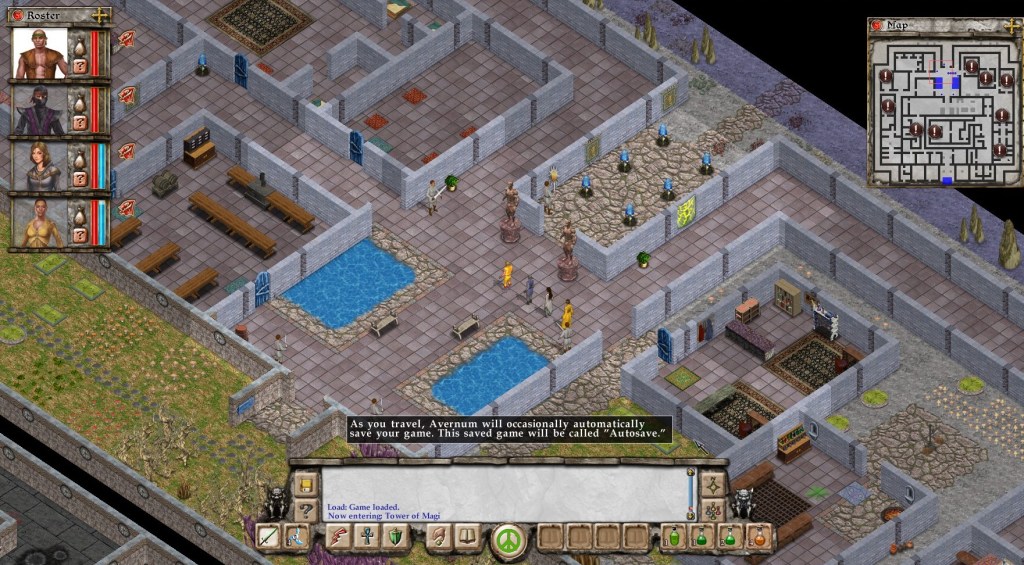
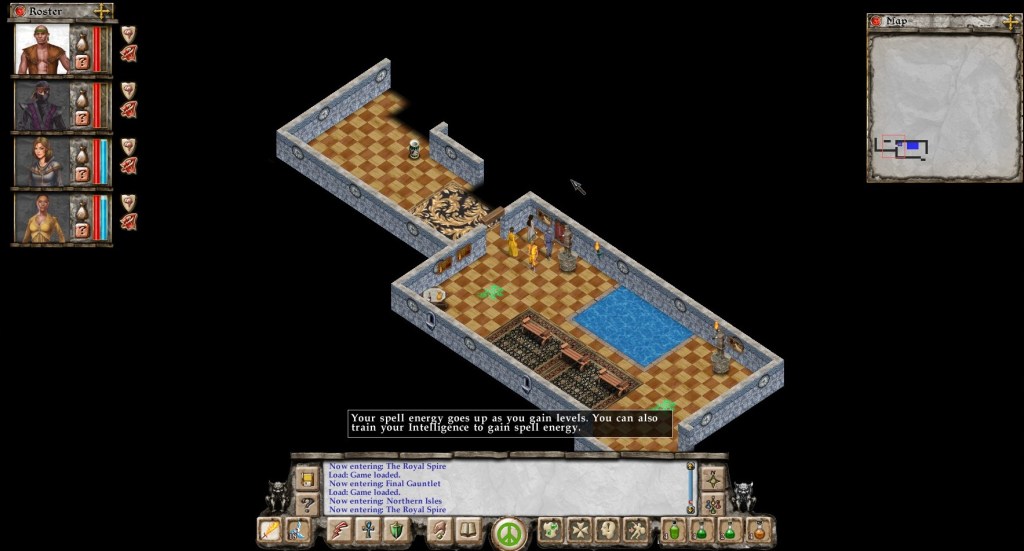
I began playing Avernum: EFTP in September of 2025. As I expected, Avernum sets the same story of Exile in the same world with the same quests in the same locations arranged in the same relative positions. And, as expected, Avernum gives Exile both a cosmetic overhaul and a suite of quality of life improvements. The perspective has changed from top-down to isometric (enabling the engine to accommodate changes in elevation), the user interfaces have undergone significant streamlining, the party size has been reduced from six to four, and, most blessedly, Ye Olde Text Parser has been replaced with dialogue trees.
And yet, as befits a 15 year-old revision of a 26 year-old indie game, almost nothing about the presentation or gameplay of Avernum: EFTP is built to contemporary standards of player friendliness. Sprites and other art assets are reused constantly, to the point that two NPCs that share the same basic job will have the exact same sprites. While key bindings require two keystrokes to prevent accidental inputs, mouse clicks offer no such fail safe. Learning the point-and-click controls seemed simpler and easier to me than learning the many key bindings, but there’s nothing simple and easy about accidentally sending your party halfway across the map without meaning to.
I had much better success using the keyboard whenever possible, but I also have a keyboard with a number pad (which gives the player full eight-directional keyboard movement) and the experience from years of toil in the data entry mines to use it effectively. If your keyboard doesn’t even have a number pad – and I know for a fact that many keyboards on the market these days do not – you will either have to get by with the arrow keys or the mouse. And, lest you rush into the game believing that being stuck with arrow keys will be just fine, remember that the game uses an isometric perspective. This means that the cardinal directions (that is, the ones you are committing to moving along exclusively) are along the diagonals, so using the arrow keys is both limiting and confusing.
Furthermore, the game’s sheer size – the vast amount of territory to explore, the vast amount of locations and secrets to find, and the vast amount of quests to complete – is overwhelming beyond the scope of even other purposefully overwhelming CRPGs. The introductory fort gives the player a small handful of quests and instructions on how to reach the next towns over, and visiting either will swamp the player with quests. And, of course, there’s no point in playing a game this open without exploring, and there are even more quests to find out in the game’s great wide expanse. While some of the early game quests are trivial, many will prove brutally difficult without getting a few level-ups and some improved equipment. It is going to be a long, long time before you start to clear more quests than you receive. And in a world this big in a game this primitive, it will not surprise you to learn that there are fetch quests aplenty. Sometimes the quest giver will tell you where to look, but not always. To put a bow on all of this, it is possible to lock yourself out of completing at least one of the game’s three endgame quests. Granted, it requires playing like a real jackass, but it is possible.
All of this gave me some degree of trouble, but what really slowed my progress was the combat balancing. While combat encounters with regular enemies are quick and easy, elite enemies and bosses have hit points and defenses far in excess of their minions to go along with their superior offensive stats and abilities, and in these battles the pace of combat grinds to a brutal halt. I found my patience tested time and time again as I went through dungeon after dungeon overcoming all obstacles until a long and boring boss fight or three devolved into a rote slog of keeping my party upright while digging as deep into my bag of tricks as I could. Sometimes I succeeded, sometimes I succeeded only after turning the difficulty down to its lowest setting, and sometimes I decided it was better to leave the dungeon entirely until I felt powerful enough to try again.
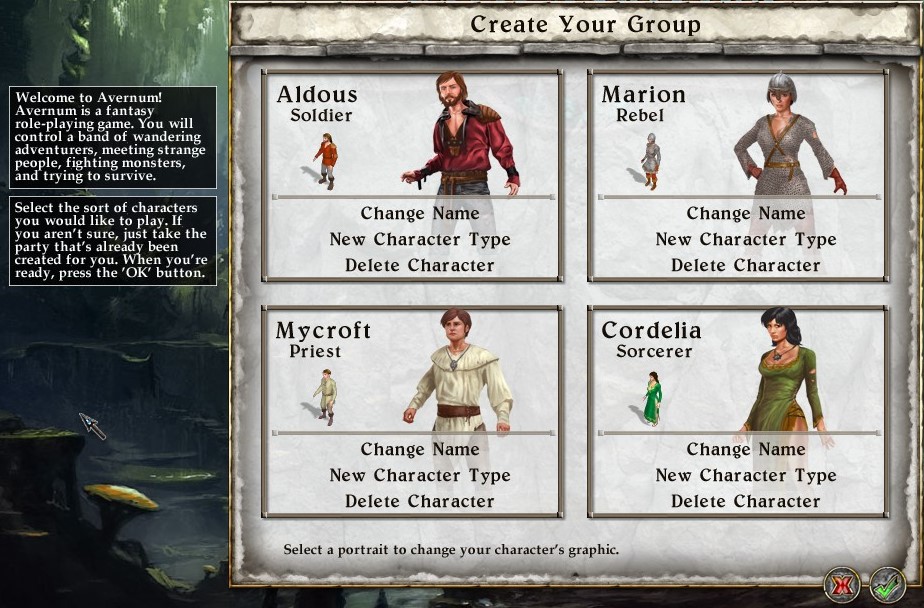
This dynamic wore thin, as it recurred over and over again even as I advanced into the midgame. Naturally, my struggles in combat led me to question my party’s build. While Avernum sports a remarkably straightforward build system, it also does not use an actual class system. A party member’s capabilities are merely the sum of their stats, gear, and player selected special abilities, many of which merely provide additional stat boosts. The player can choose a ‘class’ when generating a party at the start of the game, but these ‘classes’ are just preset bundles of stats and traits. When I struggled with a particular dungeon or combat encounter, I found it all too easy to question my strategic acumen. There are no traditional respecs Avernum: EFTP, rather, there is a Character Editor which allows you to change any party member’s stat to anything at any time. In other words, the Character Editor is a cheat mode, and where’s the fun in that?
My worries about build choices then evolved to a broader, more existential strain of gaming anxiety. This form of anxiety defies easy categorization, but to sum up, I felt I was blundering from dungeon to dungeon and town to town and quest to quest instead of making active, informed decisions about what to do next. Every quest I tried felt too hard, and the ones I hadn’t even tried yet looked scary and felt scarier after all my other failures. How many milk run quests, special items, and spells (long story short, you do not learn any new spells from gaining levels) had I missed, and how much time and energy was I willing to spend to backtrack in search of them? Am I playing this game the right way at all?
And so, after about 40 hours of advancing slowly, I started to get sick and tired of all this angst, so I put Avernum: Escape From the Pit off to the side in favor of yet another playthrough of Mass Effect: Legendary Edition.
*****
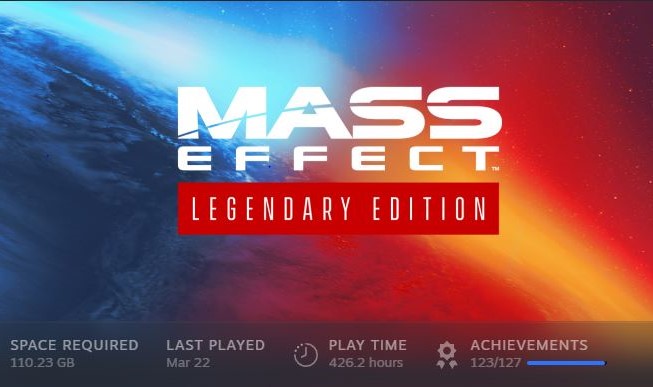
Surprise! As part of my ongoing mission to alienate as many longstanding, current, and potential readers as possible, it is once again time to change topics unexpectedly and without warning, this time in service of talking about Mass Effect, again. Why I do I keep coming back to Mass Effect, despite the original trilogy’s many and obvious flaws, and a gaming backlog that spans the length of the continental United States?
For a long time, I figured that the reason I held the original trilogy in so high a regard was, essentially, a matter of impressionability. Debate how well the trilogy holds up all you want, the fact of the matter is that its combination of tactical third-person shooting, RPG character progression, and epic choices matter storytelling, all wrapped up in a AAA-developed package, felt nothing less than miraculous in its day. And, since its day happened to coincide with the post-college dirtbag rumspringa that was my early-to-mid-20s, the series came to me at the exact right time and place.
While there is a lot to this impressionability theory, it is only part of why Mass Effect has held such a stranglehold on my gaming sensibilities. The full truth only became apparent to me a few years ago, when I bought and played through Legendary Edition for the first time. It was only then that I actively realized that the combination of high-fantasy style dungeon crawling set with the aesthetic trappings of a syndicated sci-fi show from the 90s hits my precise Nerd G-Spot. I have spent the vast bulk of my life’s leisure time chasing the highs of watching Star Trek/Star Wars and playing tabletop RPGs and CRPGs alike as a kid, and the Mass Effect Trilogy merges both into near-perfect harmony.
Or, at least, some degree of harmony. Or, at absolute bare minimum, something close enough to actual harmony to pass for the real thing. It’s complicated.
Let me explain. I am drawn to CRPGs in part for their own sake but also as a simulacrum of the tabletop RPG experience. A good session of a tabletop RPG is more fun than words can describe, but finding time for any group of ostensible grown-ups to play tabletop with any regularity is monstrously difficult, and finding any time for playing or running a tabletop game while also serving as a stay at home parent to two young kids is just about impossible. My only outlet for the bottomless store of mental energy I would prefer to use in service of running a tabletop game is CRPGs, and I am constantly on the lookout for new CRPGs that can serve as this outlet.
It also means when I play any kind of CRPG, I end up forming all kinds of opinions on how that game does and/or does not reflect the tabletop RPG experience, and the Mass Effect trilogy is no exception. Mass Effect gives its players dungeons to crawl through and the story to justify it, but it also railroads the player time and time again. For those unfamiliar with tabletop RPG jargon, railroading is the most commonly accepted term for a Game Master forcing the players into a specific course of action. Most tabletop players are OK with a certain amount of railroading. They want to play through the adventure the GM prepared too, and they understand that the GM can’t anticipate every course of action action a player or group of players may choose to pursue. Therefore, they are unlikely to mind when the GM politely ushers the group to the adventure module’s dungeon entrance instead of letting them wander off in the opposite direction to become pirates or whatever.
But railroading can cause problems in a tabletop session, particularly when a player or group of players feels as though the GM is stopping them from taking a reasonable course of action. (As a particularly egregious example, I remember a particular Reddit thread from several years ago in which a player was complaining about how their GM wouldn’t let the party enter a walled city by scaling the walls, instead insisting that they go through the main gate in order to trigger a specific story beat.) And the thing with Mass Effect is that it railroads the player all the damn time, in ways both big and small. The moral choice and dialogue systems are strictly binary. The plot progression stays bolted in place, regardless of the many decisions the player makes. In Mass Effect 3, there is a particularly obnoxious unwinnable ‘battle’ against one of the main antagonists. Why let the player play this battle if you won’t let them succeed? And why is Commander Shepard always using a goddamn assault rifle in cutscenes!? My Shepard uses shotguns exclusively!
My point here is that while I had a great time running through the Mass Effect trilogy yet again, I was also a bit sick of its bullshit by the end. It gave me a fix of dungeon crawling and tactical combat and large-sale storytelling, but this fix came within the constraints of the trilogy’s constrained possibilities. This is the Faustian bargain at the heart of almost all of BioWare’s catalog. We will give you all of the things you like about tabletop RPGs – well, almost all of them – but in exchange, we will take away the game’s capacity for emergent storytelling. We will tell you the game’s story with cutscenes and dialogues. We will not show you the story with gameplay.
*****
At any rate, I had to keep feeding the CRPG monster somehow once I finished Mass Effect: Legendary Edition, and since I have enough games in my library already, I chose to do so with the games I already had. And so, a good four or five months after setting Avernum: Escape From the Pit off to the side, I picked it back up right where I left off…which happened to be smack in the middle of a dungeon my party wasn’t really ready for, located in the middle of nowhere on the world map. D’oh! It was a rude re-awakening, to say the least.
If I was going to get back into Avernum, I would need to find a way to escape the frustrating, stop/start gameplay loop was caught in. At first, I tried to force my way through the dungeon I was already stuck in, only to find that the battles were still a drain, and only got harder as I went deeper. I would have to take my chances with one of the other quests that were available and hope that I could, with a little bit of luck and a lot of patience, find a quest dungeon that my party could actually handle and eventually complete. To start, I picked a quest that required me to break into an enemy castle and slay an evil king. This sounded daunting, and maybe this dungeon would suck too, but at least it wouldn’t be a bore.
And so, I went to the evil king’s castle and hoped for the best. Once I got there, everything about Avernum: Escape From the Pit clicked.
How should I get into this castle? Do I storm the front gates, or do I sweep the perimeter and look for a way to sneak in? Now that I’ve found a way to sneak in, are there any guards nearby, and can I get the jump on them by starting combat manually? After, Avernum lets the player do that whenever they want, just like Baldur’s Gate 3 does. Now that I’ve found the guards and started fighting them, how many other guards have been alerted, and how much time to I have to reposition my party to fight out of a corner effectively? Oh crap, there’s an enemy priest! Is there any way I can take it out immediately without compromising my tactical setup? Phew, that fight was dicey, but now there’s time to heal up and decide whether to keep exploring the castle or return to the nearest town to rest. Let’s keep exploring. Do I want to sneak around the main hall and go up the stairs to the next floor, or do I want to take on the massive (and massively powerful) enemy force in the main hall?
What this sequence made me finally realize is that Avernum is an actual, honest-to-Orcus capital-A Adventure. In direct contrast to Mass Effect and most of the other story-driven CRPGs I tend to favor, which often rely on overt railroading in order to preserve specific plot elements, Avernum gives the player the choice of what happens, and when it happens, and how it happens. In this way, the ‘GM’ of the game is closer to a specific and specifically old-school ideal of a tabletop GM. In this idealization, it is not the GM’s job to craft an entire story for the players to walk through. Rather, it is the GM’s job to furnish and maintain a sandbox for the players so that the player characters drive an emergent story through their actions.
Notice how this idea is implemented in the above example. I planned and executed my own strategy for breaching the evil king’s castle, and in so doing told a unique version of the story of what happened when a group of adventurers infiltrated the evil king’s castle. Other players of Avernum told the story their own ways, and some of those ways assuredly looked a heck of a lot like mine, but it is all but impossible for the same quest to play out in the exact same way twice. After another 100+ hours of the Mass Effect trilogypolitely but firmly ushering me through the same familiar set pieces, I was ready to appreciate the radically different, player freedom-oriented approach Avernum offers its players.
This appreciation accelerated as I continued playing. Slaying the evil king was not only a quest my party was ready for, it also pushed my party over the hump of the power curve. I emerged with more levels, better gear, and improved spell casting, all of which helped me gain a better understanding of the combat system, which in turn helped me refine my strategies and tactics. All of a sudden, the scarier quests weren’t so scary to complete and the scarier regions of the map weren’t so scary to explore. And sure, I still stumbled into fights and dungeons I was not ready for from time to time, but once I was picking up what Avernum was putting down, these fed into the sense of adventure. The fear that I would run into a battle, monster, or dungeon I couldn’t handle turned into excitement, and I became grateful to have found a game that pulls no punches. No fun without danger, after all.
Once I gained the confidence to explore freely, I simultaneously racked up quest completion after quest completion and found that the story had slowly but surely crescendoed from a low murmur to a deafening blast. The quests themselves grew in scope, and many seemingly loose strands of characters, factions, and plots became a lot more interconnected than I thought possible for a game of this technical vintage. I even saw the writing itself in a new light. What once appeared as purely functional text in service of a bare bones excuse plot proved to be, on closer inspection, a masterclass in fueling imagination using as few words as possible. Seriously, if Ernest Hemingway were alive today, his favorite video game would be Avernum.
All of this is to say that gaining a surface-level appreciation for what Avernum is and how its core gameplay loop operates set off a chain reaction that resulted in a deep, abiding love. A game that I originally regarded as a fussy, old-school curiosity ended up sucking me into its world completely, until I had completed all three of the major endgame quests, securing revenge for my party against the Empire and validating 9-year old Rob’s struggles to get anything done in Exile all those years ago. And let me tell you, the mission to return to the surface and assassinate the emperor who sentenced your party is frantic, desperate, and difficult to a degree that puts Mass Effect 2‘s venerated ‘suicide mission’ to shame.
*****
Yet I must admit that Avernum simply is not for everybody. Hell, I wasn’t sure Avernum was for me until I had pumped well over 40 hours into it, and I can’t be certain I would’ve even come around on it had I not first gorged myself on one of my most reliable gaming comfort foods. The graphics are limited. The quality of life measures are not at all up to contemporary standards. There is only one quicksave slot and a paltry 18 manual save slots to augment a single autosave feature that seems to save games constantly, but never when you want it to. I had to backtrack through discouraging amounts of gameplay multiple times after the autosave gods saw fit to abandon me.
While Avernum can play very quickly, the initial learning curve is quite steep. Movement is goofy and disorienting prior to mastery, combat is demanding and unforgiving from the start, and most players will find the lack of explicit direction daunting, if not overwhelming. In-game tutorials are minimal and concise to a fault. You must either blunder your way towards an understanding of the game’s mechanics or read the extensive in-game instruction manual from start to finish. Realistically, you will have to do a bit of both. And, perhaps most importantly for contemporary gamers, I wasn’t kidding when I said you can lock yourself out of even the most plot-important quests if you’re not careful.
In other words, Avernum: Escape From the Pit is a lot, which is scary in its own right and made even scarier by the primitive, even quaint presentation. But for all that Avernum lacks in technical prowess, it is nothing less than a masterclass in game design, and in accomplishing more with less. The game world is massive, open, and packed with points of interest while still leaving plenty of wide open spaces. The many dungeons and quests are remarkably non-repetitive. The combat system looks simplistic at first, but is packed with tactical and strategic nuance; it is easy to learn, but difficult to master. Avernum makes a point of telling its players as little as possible, so that each and every one can show the game to themselves.
Put in the work Avernum demands of its players, and you will be rewarded with an experience that remains unique among CRPGs, even after the ensuing decades of gaming progress. Ask yourself, do you want your open world RPG experience to be an unceasing grind of sterilized, guaranteed to be level-appropriate task checklists, or do you want to go on Adventure?
Highest recommendation!